
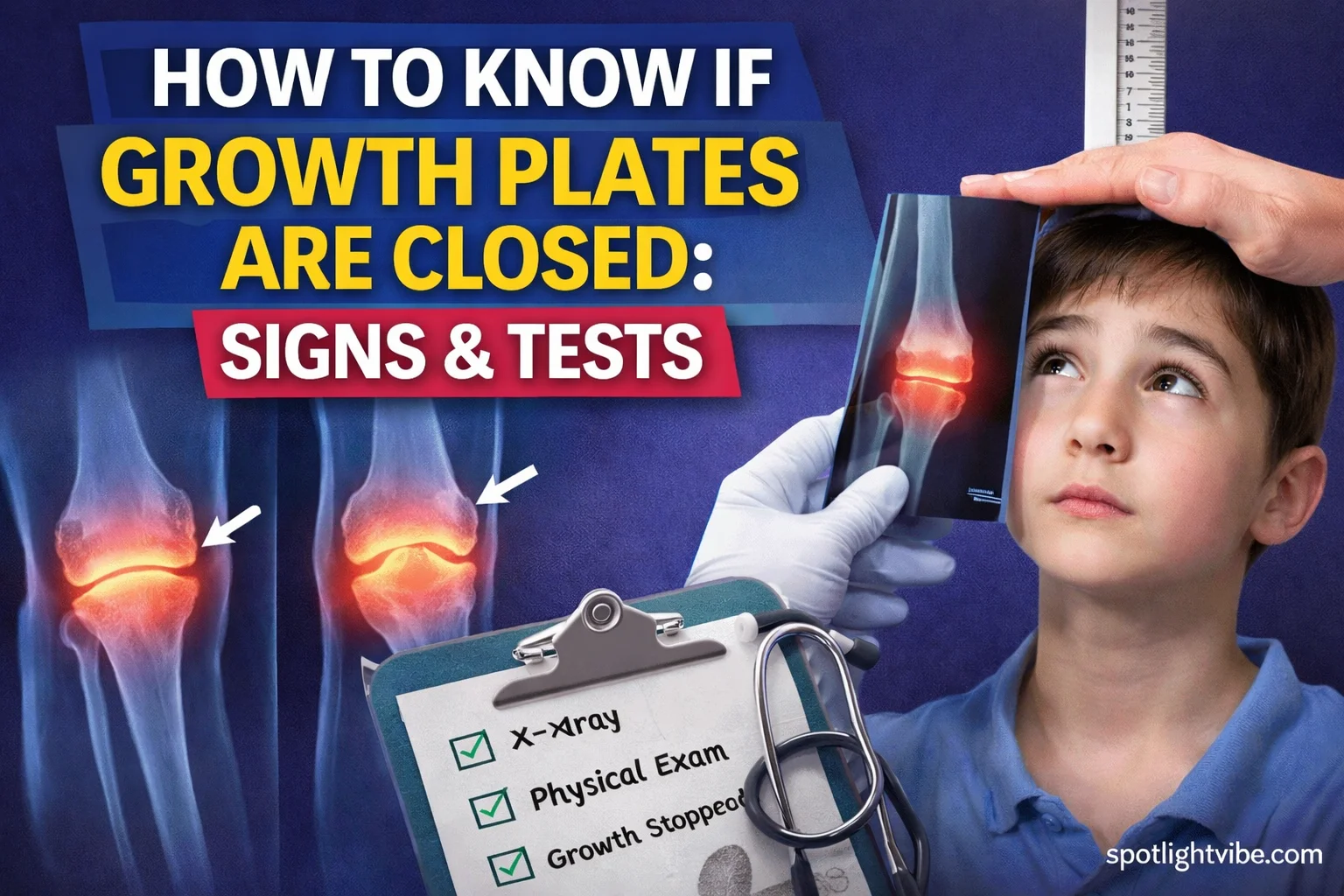
If you are wondering whether you or your child has stopped growing, the key question is: are the growth plates closed? Knowing how to know if growth plates are closed helps parents, teenagers, and young adults understand where they stand in their physical development.
The truth is, the only way to be 100% sure is through a medical X-ray. But there are several physical signs, age-based patterns, and puberty milestones that can give you a strong, reliable idea before ever visiting a doctor.
This guide explains everything clearly, from what growth plates actually are to how doctors confirm their closure.
What Are Growth Plates and Why Do They Close?
Growth plates, also called epiphyseal plates, are thin areas of soft cartilage located near the ends of your long bones. They are found in the legs, arms, hands, and feet. During childhood and adolescence, these plates are the active zones where new bone tissue is created, making your bones longer and your body taller.
Growth plates are active during childhood and adolescence. They close after you are done growing and are replaced by solid bone.
The closing process is called ossification. When sex hormones surge during puberty, they send a signal to the growth plates to stop producing new cartilage. Over time, the cartilage hardens completely into solid bone. Once that happens, no further height increase is possible.
At What Age Do Growth Plates Close?
There is no single age that applies to everyone. Timing depends on sex, genetics, hormones, and overall health. However, research gives us solid general ranges.
For girls, most growth plates close between ages 14 and 16, often within 1 to 2 years after the first menstrual period. For boys, most close between ages 16 and 18, sometimes later if puberty starts late.
On average, females stop growing around age 13 to 15, and boys around age 15 to 17. Many children continue to gain some height into their late teen years, but the vast majority of growth is over by these ages.
It is also important to know that not all growth plates close at the same time. Those in the hands and feet tend to close before the larger, long bones like those in the legs.
How to Know If Growth Plates Are Closed: Key Signs
1. Height Has Stopped Increasing
The most observable sign is a complete stop in height. If you have not grown even a centimeter over the past 12 months or more, it is a strong signal that your growth plates have fused or are very close to closing.
Track your height monthly for at least a year. Measure at the same time of day, ideally in the morning, since you tend to be slightly taller after waking up. If there is zero change, your bones have likely stopped lengthening.
2. Completion of Puberty Stages
Growth plate closure is directly tied to puberty. Doctors use a system called the Tanner Scale, which has five stages of pubertal development. When a person reaches the final stages of puberty, known as Tanner Stage 5, it is a reliable indicator that growth plates are essentially closed.
For girls, reaching Tanner Stage 5 means full breast development and the start of regular menstrual cycles. For boys, daily shaving and regular menstrual cycles beginning for girls are general markers that puberty is over and growth is close behind.
3. Shoe Size Has Stabilized
Feet grow early during puberty, often before long bones in the legs. A shoe size that has not changed for over a year can indicate that growth is completing.
This is not a definitive sign on its own, but when combined with stopped height growth and completed puberty, it adds to the overall picture.
4. Growth Spurts Have Ended
During puberty, most people experience one or two rapid growth spurts where they gain several centimeters in a short time. Most children grow an average of two years after they have completed their most rapid pubertal growth spurt.
If it has been two or more years since you noticed any significant growth, and you are past your main pubertal growth spurt, your growth plates are very likely closed or in the final stages of closing.
5. Family Height Patterns
Genetics plays a major role in both when growth plates close and what your final height will be. If both of your parents completed their growth relatively early, there is a higher chance you will follow a similar pattern.
While family height is not a definitive indicator, it is a useful piece of the puzzle when you are trying to assess where you stand without medical testing.
The Only Definitive Method: X-Ray and Bone Age Testing
All of the signs above are helpful, but none of them are conclusive on their own. The most reliable method is a bone age test, which is an X-ray of the hand and wrist. It compares bone development to age-based standards to predict remaining growth potential.
How a Bone Age X-Ray Works
During this test, a doctor takes an X-ray of your left hand and wrist. The image is then compared to a standardized reference called the Greulich-Pyle atlas. A radiologist or doctor compares the patient’s X-ray to this atlas to determine the patient’s “bone age.” If the atlas shows fusion and the patient’s X-ray matches, the growth plates are considered closed.
On an X-ray, open growth plates appear as dark lines or gaps near the ends of bones. These dark lines disappear once the growth plates have fused into solid bone.
When Is an MRI Used Instead?
In certain cases, MRI can assess specific growth plates, like those in the knee or hip, with even greater detail than an X-ray. MRI is often used when a doctor needs a more precise look at a specific area, such as after a sports injury or when evaluating a growth disorder.
Factors That Affect When Growth Plates Close
Several things can cause growth plates to close earlier or later than the typical age range.
Hormones: Estrogen is the primary hormone that triggers closure in both males and females. Higher estrogen levels can accelerate the process. A 2020 study found that complete closure occurs approximately 2 years earlier in girls than in boys, and that body mass index also plays a role, with growth plates closing earlier in individuals who are overweight, potentially due to increased adipose tissue and its associated hormones.
Nutrition: A diet low in protein, calcium, and key minerals can delay bone development and growth plate closure. Children who are malnourished may experience delayed closure.
Early Puberty: When children have a puberty growth spurt too early, their growth plates may also close too early. This means children with early puberty seem tall at first, but then stop growing sooner than their friends, and they end up shorter than expected.
Medical Conditions: Certain hormonal disorders, chronic illnesses, and long-term use of corticosteroids can affect the timing of growth plate closure. If you or your child has a health condition that affects hormones, consult a pediatric endocrinologist.
Why Knowing Growth Plate Status Matters
Understanding whether growth plates are still open is not just about height. It has real medical and practical significance.
Knowing when growth plates are closing is critical for height prediction, treatment decisions since growth-promoting treatments like growth hormone therapy only work before plates close, and sports safety since open plates are more vulnerable to fractures in high-impact sports.
Because of their soft nature, growth plates are vulnerable to injury during development. Up to 30% of fractures in children can occur around the growth plates. For young athletes, this is an important reason to consult a doctor before engaging in heavy lifting or high-impact activities.
Conclusion
Knowing how to know if growth plates are closed involves watching a combination of physical signs: stopped height growth, completion of puberty, stabilized shoe size, and the end of growth spurts. These indicators together give a strong picture of whether skeletal maturity has been reached.
However, for a definitive answer, a bone age X-ray is the only reliable tool. If you are a parent concerned about your child’s growth, or a teenager unsure of where you stand, the best step is to speak with your doctor.
Early awareness leads to better decisions, whether that involves nutrition, sports participation, or exploring medical options while the window is still open.
Frequently Asked Questions
Can I check if my growth plates are closed at home?
You cannot confirm it definitively at home, but physical signs like stopped height growth, completed puberty, and stabilized shoe size are strong indicators worth tracking.
Does stopped height growth always mean growth plates are closed?
Not always. Growth can temporarily slow before plates fully fuse, so a bone age X-ray is the only way to confirm closure with certainty.
Can growth plates reopen after closing?
No. Once growth plates fully fuse into solid bone, the process is permanent and cannot be reversed naturally.
At what age should I see a doctor about growth plate concerns?
If your child shows signs of very early puberty, unusually slow growth, or no height increase for over a year before age 13, a pediatric doctor or endocrinologist visit is recommended.
About the Author